
Sarcoma Types
Sarcoma is not a single disease- it's a group of rare cancers that begin in connective tissues like muscle, fat, nerves, blood vessels, cartilage, and bone. Doctors identify the type of sarcoma by where the tumor starts and how the cells look under the microscope. Knowing the exact subtype helps tailor treatment and predict how the tumor will behave. There are two main types of sarcoma that are made up of many different subtypes. The most common is soft tissue sarcoma. The least common type of sarcoma is osteosarcoma, or bone sarcoma.
Soft tissue sarcomas (STS)
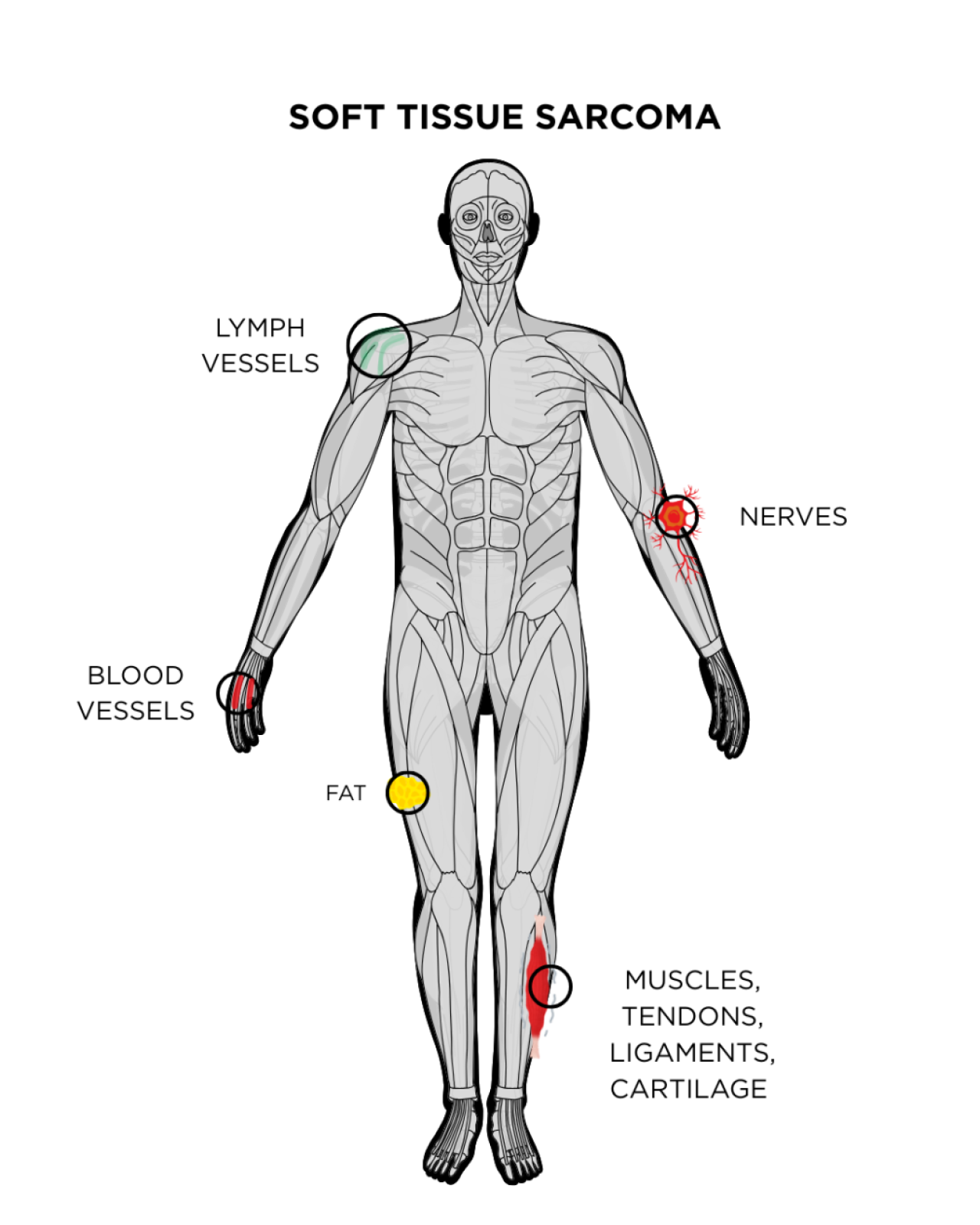
Soft tissue sarcomas affect both children and adults. About 60% of these sarcomas begin in an arm or leg, 30% start in the trunk (torso) or abdomen, and 10% occur in the head or neck.
There are at least fifty different subtypes of soft tissue sarcoma (STS). The most common soft tissue sarcomas are listed below, according to the body systems they affect. Symptoms and treatment can vary by type.
Gastrointestinal stromal sarcomas (GIST)
One of the most common types of sarcomas, GIST starts in the gastrointestinal tract. GIST tumors are unique because their growth is driven by a mutation in a gene called C-kit, which is not found in other sarcomas. The discovery of C-kit and the invention of drugs that block it have revolutionized the treatment of this disease.
Liposarcomas
The other most common type of soft tissue sarcoma, liposarcomas begin in fatty tissues. Subtypes (well-differentiated, dedifferentiated, myxoid, pleomorphic) range from slow growing to aggressive, so precise diagnosis is needed to determine treatment.
Alveolar soft-part sarcoma (ASPS)
ASPS is a very rare, slow-growing tumor that often arises in the legs of adolescents and young adults but can spread to other parts over time.
Leiomyosarcoma
Leiomyosarcoma develops from smooth muscles (for example, in the uterus or abdomen). It can occur almost anywhere that smooth muscle is present.
Fibrosarcoma
Fibrosarcoma grows from fibrous connective tissue. This type is now uncommon due to improved diagnostic tools that reclassify many cases into other subtypes.
Fibrohistiocytic tumors (e.g., undifferentiated pleomorphic sarcoma / UPS)
Fibrohistiocytic tumors typically occur in the arms, legs, or retroperitoneum. These tumors can grow quickly and may spread, so early diagnosis is key.
Rhabdomyosarcoma (RMS)
RMS forms in skeletal muscle and is more common in children and teens. Treatment often involves multimodal therapy.
Dermatofibrosarcoma protuberans (DFSP)
DFSP is a skin-based tumor that tends to grow locally and recurs if not fully removed. Targeted therapy may help in select cases.
Low-grade fibromyxoid sarcoma
Low-grade fibromyxoid sarcoma often presents as a painless, slow-growing mass in the limbs or trunk. Despite its low-grade appearance, it can recur or spread.
Angiosarcoma
Angiosarcoma starts in blood or lymphatic vessels. It can develop in the skin, soft tissue, breast, or liver and may grow and spread rapidly.
Synovial sarcoma
Synovial sarcoma usually affects the arms or legs near joints or tendons in adolescents and young adults. It often presents as a deep, painful mass.
Epithelioid sarcoma
Epithelioid sarcoma typically begins under the skin of the hands, forearms, or lower legs and may form nodules. It has a tendency to recur.
Nervous system: Malignant peripheral nerve sheath tumor (MPNST)
MPNST originates from the cells around peripheral nerves and can be associated with neurofibromatosis type 1. It often needs expert multidisciplinary care for diagnosis and treatment.
Benign growth and intermediate soft tissue tumors
Many benign tumors are found in soft tissues- and are not cancer. These tumors don’t behave exactly like classic cancers and are called intermediate soft tissue tumors. Examples include desmoid (fibromatosis) and some solitary fibrous tumors. Management of such tumors depends on the type and may include observation, medication, or surgery.
Some growths resemble sarcoma on scans or exams but are also not cancer. Common examples include lipomas (fatty tumors) and some vascular lesions. They may need treatment if they grow, cause symptoms, or are uncertain on biopsy. However, more often than not, they are harmless.
Bone sarcomas
Three main sarcoma subtypes (osteosarcoma, Ewing’s sarcoma, and chondrosarcoma) begin in the bone. Because their symptoms and treatments differ, accurate diagnosis is very important.
Osteosarcoma
Osteosarcoma is a type of bone cancer that mostly occurs in children, teens and young adults. About 80% of these tumors start in bones around the knee, but they can also be found in the thigh, upper arm, and shin bones. These sarcomas can spread to the lungs, requiring a combination of surgery to remove the tumor and chemotherapy to treat anywhere else the disease may be hiding in the body. With surgery and chemotherapy, this tumor is considered curable in most cases.
The following subtypes of osteosarcoma grow at different rates and have different chances of spreading to other parts of the body:
- Parosteal osteosarcoma rarely penetrates the center of the bone or turns malignant. These tumors generally arise in the femur or behind the knee.
- Periosteal osteosarcoma is an aggressive tumor, affecting the tibia (the larger of the two bones between the knee and ankle). It is mostly made up of malignant cartilage.
- Osteosarcoma of the jaw and skull. Osteosarcoma of the facial bones is relatively rare and is generally found in patients between the ages of 20 and 40. Because these tumors are in the head and neck, they tend to be diagnosed earlier and take longer to spread. Because they’re hard to remove with surgery, the cancer is more likely to come back in the same area.
- Telangiectatic osteosarcoma is a lesion affecting the long bones of the arms and legs. The prognosis (survival rates) for patients with these tumors has improved in the past few years.
Ewing’s sarcoma
Ewing’s sarcomas, or Ewing’s tumors, occur primarily in children and young adults under 30. These sarcomas usually form in the pelvis, chest, or legs. Through surgery and chemotherapy, the majority of patients with this sarcoma are cured of their disease. There are three types of Ewing’s sarcoma: Ewing’s sarcoma of the bone, Extraosseous Ewing tumor (EOE) and peripheral primitive neuroectodermal tumor (PPNET).
Chondrosarcoma
Chondrosarcoma is a cancer of cartilage and is found in the larynx and respiratory tract, the outer ear, and on the surfaces of joints. These tumors are found in adults between the ages of 20 and 60. They usually start in the pelvis and move to other areas of the body. Chondrosarcoma accounts for roughly one third of all bone cancers. For these tumors, surgery is the main treatment since they tend not to respond well to chemotherapy.